It has been related that a man said, "Oh Messenger of Allah, I indeed love you." He (Allah bless him and grant him peace) replied, "Prepare for poverty." The man then said, "I indeed love Allah (Exalted is He!). He replied, "Prepare for tribulation."
(Reported in Tirmidhi, taken from Ghazali, Kitab al-Mahabbah wa'l-shawq wa'l-uns wa'l-rida' from the Ihya' 'ulum al-din, 6:181)
Tuesday, January 31, 2006


Friday, January 27, 2006
Envy Corrodes Faith...
God bestows good fortune on whom He will. Then why do you feel jealous and wish that another be dispossessed of all his prosperity? Do you know in your wrath you deem yourselves equal to God? Behold, you will be depraved, because envy corrodes faith and leads to the ultimate fall. Bear in mind Joseph, who despite his brothers' loathsome schemes, remained the illustrious. And who but the brothers were disgraced? Take heed, time and again our Lord warns us against the ills of envy.
- Sheikh Abdul Qadir Jillani, Futhul Ghaib, pp. 103-104
- Sheikh Abdul Qadir Jillani, Futhul Ghaib, pp. 103-104
Once the ego is overcome peace follows...
Once the ego is overcome peace follows. "Only God and no living creature has the power to control destinies." With that conviction entrust all your cares to the Lord and follow the path of the Truth, conforming to the divine edicts, until you attain union with Him and become as pure as Adam before whom all creatures prostrated.
- Sheikh Abdul Qadir Jillani, Fayaz e Yazdani, p. 341
- Sheikh Abdul Qadir Jillani, Fayaz e Yazdani, p. 341
Wednesday, January 25, 2006
Zaid's (Caravan Saray)
A dear friend of mine recently made the Hajj, alhamdulillah, and as I looked around for a nice gift to send her, I decided to shop online given we live far apart. I landed at Zaid's, found a beautiful gift for her, and had an excellent shopping experience in the process!
 So, if you're looking for a beautiful gift for someone special or you simply would like to treat yourself to something nice, Zaid's -- formerly Caravan Saray -- is an excellent first stop. It brings together some of the best, most unique Islamic products out there, together on one convenient site.
Books -- Perfume -- Clothing -- Prints -- Greeting Cards, and more!
Caravans from
Shamil, Rabia Designs, Haji Noor Deen, Irfan, Oriscent, Islamica, Siratt, and Wakeel Books...
Check it out.
Sunday, January 22, 2006
Listen to your heart and not your ego. ..
Do not deem yourself prudent, for as long as you are attached to the world, you have neither prudence nor sense. Turn to God and seek forgiveness if you wish to prevail. Listen to your heart and not your ego. Your ego prompts you to boast of vain assertions to obtain the glory of this world. Turn away from vanity and seek Him in the recesses of your heart and soul. Show patience in adversity and be content in His will that you may attain proximity to God.
- Shaykh Abdul Qadir Jillani, Fayuz e Yazdani, p. 216
- Shaykh Abdul Qadir Jillani, Fayuz e Yazdani, p. 216
How shall I describe my state...?
Bereft of life, bereft of knowledge,
bereft of power and will,
how shall I describe my state?
For I do not exist; only He exists.
I am deaf; the hearer is He.
I am blind; the seer is He.
I am mute; the orator is He.
I do not exist; only He exists.
- Shah Kamal, Islamic Sufism, p. 101
bereft of power and will,
how shall I describe my state?
For I do not exist; only He exists.
I am deaf; the hearer is He.
I am blind; the seer is He.
I am mute; the orator is He.
I do not exist; only He exists.
- Shah Kamal, Islamic Sufism, p. 101
Wednesday, January 18, 2006
Let not the cares of this world drive your peace away...
Whenever you are tempted by this world,
picture a derelict covered with filth whose noxious
odor is intolerable. Reviled you will shut your
senses to the offensive sight. In the like manner
stay away from abomination of sin that may
deface your purity. The Lord shall bless you
with much bounty; therefore let not the cares
of this world drive your peace away.
- Shaykh Abdul Qadir Jillani, Futhul Ghaib, p. 20
picture a derelict covered with filth whose noxious
odor is intolerable. Reviled you will shut your
senses to the offensive sight. In the like manner
stay away from abomination of sin that may
deface your purity. The Lord shall bless you
with much bounty; therefore let not the cares
of this world drive your peace away.
- Shaykh Abdul Qadir Jillani, Futhul Ghaib, p. 20
Saturday, January 14, 2006
O Lord...Give me... (Salikah Archives)
Khwajah 'Abdallah Ansari, said in his Supplications (Munajat):
I live only to do Thy will,
My lips move only in praise of Thee
O Lord, whoever becometh aware of Thee
Casteth out all else other than Thee.
O Lord, give me a heart
That I may pour it out in Thanksgiving
Give me life
That I may spend it
In working for the salvation of the world.
O Lord, give me understanding
That I stray not from the path
Give me light
To avoid pitfalls.
O Lord, give me eyes
Which see nothing but Thy glory.
Give me a mind
That finds delight in Thy service.
Give me a soul
Drunk in the wine of Thy wisdom
- One of my favourites from the Salikah archives
I live only to do Thy will,
My lips move only in praise of Thee
O Lord, whoever becometh aware of Thee
Casteth out all else other than Thee.
O Lord, give me a heart
That I may pour it out in Thanksgiving
Give me life
That I may spend it
In working for the salvation of the world.
O Lord, give me understanding
That I stray not from the path
Give me light
To avoid pitfalls.
O Lord, give me eyes
Which see nothing but Thy glory.
Give me a mind
That finds delight in Thy service.
Give me a soul
Drunk in the wine of Thy wisdom
- One of my favourites from the Salikah archives
Rumi: Pain Becomes Joy...
When you experience pain,
ask God for forgiveness.
By the command of the Creator,
it will be eliminated.
For when He decrees, pain becomes joy,
and fetters become freedom.
- Rumi, Mathnawi, 1:836-37
ask God for forgiveness.
By the command of the Creator,
it will be eliminated.
For when He decrees, pain becomes joy,
and fetters become freedom.
- Rumi, Mathnawi, 1:836-37
Friday, January 13, 2006
Prophet Muhammad as Educator - Ustadh Fethullah Gulen
Prophet Muhammad as Educator - Ustadh Fethullah Gulen
A real educator must have several virtues, among them the following… [read on]

- Found via Seeker's Digest
A real educator must have several virtues, among them the following… [read on]

- Found via Seeker's Digest
Thursday, January 12, 2006
Rumi: Do Not Walk Blindly...
If you have no eyes, do not walk blindly;
take a staff in your hand.
If you have no staff of insight,
do not walk without a guide.
- Rumi, Mathnawi, 3:276-78
take a staff in your hand.
If you have no staff of insight,
do not walk without a guide.
- Rumi, Mathnawi, 3:276-78
Monday, January 09, 2006
Eid Mubarak!
Eid Mubarak!

Insha'Allah, I pray that Allah bless your Eid with nur and surround you all with the company of those you love.
May Allah bless you abundantly, keep you in the shade of His Mercy, and grant you the best in this life and the best in the hereafter. May those who long to make Hajj be given the opportunity to do so, and may the Hajj of those who have set out on that journey this year, have their Hajj accepted.
Amin. Amin. Amin.
Please remember me in your blessed prayers, and please make a fatiha for me if memory serves.
Also, if we've wronged anyone in the slightest, this is a good time of year to seek their forgiveness, pray for them, and to make tawbah for any sins we've committed. May Allah forgive our shortcomings and elevate our stations. Amin.
Wassalam,
Salikah
Saturday, January 07, 2006
'Ibaad of Allah: The California Redwoods...
I recently came to learn about the California Redwoods and have been in absolute awe of them...
 ...some of the world's tallest trees: old-growth coast redwoods. They can live to be 2000 years old and grow to over 300 feet tall. Spruce, hemlock, Douglas-fir, berry bushes, and sword ferns create a multiple canopied understory that towers over all visitors...
The trees are taller than Niagara Falls! Single trees have themselves lived 2000-2500 years! Subhan'Allah, when you see them, and you hear how old they are...one of the first things that comes to mind is the amount of 'ibadah these trees have made...!
"Though all the trees in the earth were pens, and the seven seas after it to replenish it, yet would the Words of God not be spent. God is All-mighty, All-wise". - Qur'an 31:27

In our capitalistic world, these trees are in danger of being cut and there is an active fight by environmentalists to save them...
"Hast thou not seen how to God bow all who are in the heavens and all who are in the earth, the sun and the moon, the stars and the mountains, the trees and the beasts, and many of mankind?"
- Qur'an 22:18
- Qur'an 22:18
 ...some of the world's tallest trees: old-growth coast redwoods. They can live to be 2000 years old and grow to over 300 feet tall. Spruce, hemlock, Douglas-fir, berry bushes, and sword ferns create a multiple canopied understory that towers over all visitors...
The trees are taller than Niagara Falls! Single trees have themselves lived 2000-2500 years! Subhan'Allah, when you see them, and you hear how old they are...one of the first things that comes to mind is the amount of 'ibadah these trees have made...!
"Though all the trees in the earth were pens, and the seven seas after it to replenish it, yet would the Words of God not be spent. God is All-mighty, All-wise". - Qur'an 31:27

In our capitalistic world, these trees are in danger of being cut and there is an active fight by environmentalists to save them...
Friday, January 06, 2006
Eid al-Adha & Fasting on the Day of 'Arafah (Thoughts & Readings)
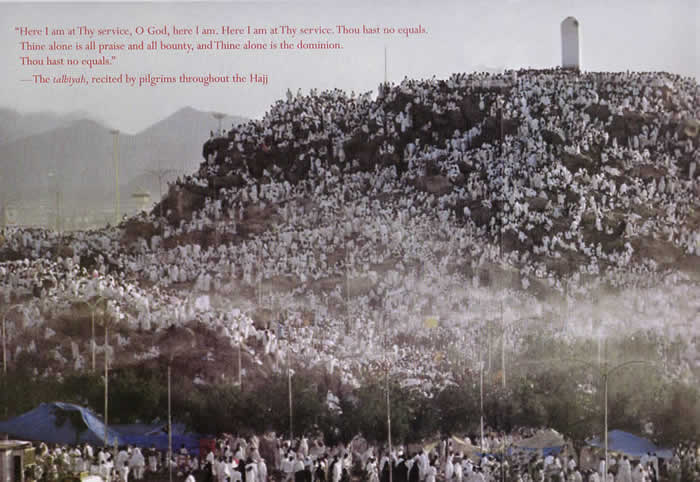
- Eid al-Adha
If you follow Local Moonsighting, then in North America, Eid is on Wednesday January 11th, 2006. See the Zaytuna Institute Site for details.
If you follow Global Moonsighting, then Eid is on Tuesday January 10th, 2006. See the Moonsighting Site or ISNA for details.
- Related Articles from SunniPath Answers:
- The Day of `Arafah: The 9th of Dhu'l Hijjah
- The Fiqh of Eid al-Adha
- The Fiqh of the ‘Eid al-Adha Sacrifice (udhiya/qurbani)
Abu Hafasah (raa) said the Prophet (saas) said: "Fasting on the day of 'Arafah absolves the sins for two years: the previous year and the coming years, and fasting on 'Ashura, (the tenth day) of Muharram atones for the sins of previous years." (Reported by Jama'ah except Bukhari and Tirmidhi)
In another hadith, the Prophet's wife Hafsah (raa) said: "Four things the Messenger of Allah never neglected: Observing fast on the day of 'Ashura, (on the tenth of Muharram), three days every month, and offering Fajr sunnah prayers early in the morning." (Muslim)
These ahadiths are proof that fasting on the tenth of Zulhijjah, the day before `Eidul Adha was a lifelong practice of the Prophet (saas) as his wife reported.
There are some reports that fasting is prohibited on the day of 'Arafah. However, it must be understood that this refers to a person performing Hajj. If a person is on Hajj, there is no fast for him or her on the day of 'Arafah. That is undoubtedly a blessing for him because of the hardships of the pilgrimage. In a hadith reported by Umm al-Fadl (raa) she said: "The companions doubted whether the Prophet was fasting on 'Arafah or not. She decided to prove to them that he was not, so she said, 'I sent to him milk, which he drank while he was delivering the Khutbah on 'Arafah.'" (Bukhari)
Prohibiting the pilgrim from fasting on these days is a great mercy for him, for fasting will exert undue hardship on the person performing the Hajj, while he is concerned with his pilgrimage. Above all, the pilgrim would not be fasting anyway because he is traveling.
Taken from Compendium of Muslim Text
A Sufi Saint of the Twentieth Century - Shaikh Ahmad al-Alawi
 A Sufi Saint of the Twentieth Century - Shaikh Ahmad al-Alawi
A good, fascinating read, if one overlooks the embedded perennialist thought. Shaykh Alawi was a true traditional murshid in every sense of the word.
An excerpt from the book in which his doctor (Dr Marcel Carret) writes of his first impression of the Shaykh:
"...‘From my first contact with him I had the impression of being in the presence of no ordinary personality. The room I was shown into, like all rooms in Moslem houses, was without furniture. There were simply two chests which, as I found out later, were full of books and manuscripts. But the floor was covered from end to end with carpets and rush mats. In one corner was a rug-covered mattress, and here, with some cushions at his back, sitting straight upright, cross-legged, with his hands on his knees, was the Shaikh, in a motionless hieratic attitude which seemed at the same time perfectly natural."
Fiqh Lists / SunniPath
For those of you who benefit from SunniPath Fiqh Answers, but who are not on the Hanafi/Shafi'i Fiqh lists, fyi, you can still join through the Hanafi and Shafi'i Yahoo! Groups.
Have all new answers delivered to an email account. It's really beneficial. When I joined it years ago I promised myself I wouldn't erase a message without reading it. Looking back, I can't tell you how much I've learned, especially with respect to contemporary issues, simply by staying up to date on my fiqh email reading.
Do yourself a favour and join :)
Have all new answers delivered to an email account. It's really beneficial. When I joined it years ago I promised myself I wouldn't erase a message without reading it. Looking back, I can't tell you how much I've learned, especially with respect to contemporary issues, simply by staying up to date on my fiqh email reading.
Do yourself a favour and join :)
Becoming Muslim: Shaykh Nuh Ha Mim Keller
 Shaykh Nuh Ha Mim Keller's account of how he became Muslim.
 Becoming Muslim is a beautiful story, well worth reading and demonstrative of how Allah can take a person and raise their station manyfold...of what Islam can do when it is properly and sincerely practiced.
May Allah preserve Shaykh Nuh and continue to guide souls through him. Amin.
Related Site: Suhba.org for lessons on tasawwuf (Sufism) by Shaykh Nuh Keller, a murshid of the Shadhili tariqa.
Thursday, January 05, 2006
Imam Ghazali on Sufism and the Reality of Spiritual Inspiration (SunniPath Answers)

Imam Ghazali's Munqidh min al-Dalal (The Deliverance from Error) is one the best books I've ever read. A short piece, I've read it on multiple occasions and it's better every time.
Imam Ghazali on Sufism and the Reality of Spiritual Inspiration (SunniPath Answers)
"... Ten years passed in this manner. During my successive periods of meditation there were revealed to me things impossible to recount. All that I shall say for the edification of the reader is this: I learned from a sure source that the Sufis are the true pioneers on the path of God; that there is nothing more beautiful than their life, nor more praiseworthy than their rule of conduct, nor purer than their morality. The intelligence of thinkers, the wisdom of philosophers, the knowledge of the most learned doctors of the law would in vain combine their efforts in order to modify or improve their doctrine and morals; it would be impossible. With the Sufis, repose and movement, exterior or interior, are illumined with the light which proceeds from the Central Radiance of Inspiration. And what other light could shine on the face of the earth? In a word, what can one criticize in them? To purge the heart of all that does not belong to God is the first step in their cathartic method. The drawing up of the heart by prayer is the key-stone of it, as the cry "Allahu Akbar' (God is great) is the key-stone of prayer, and the last stage is the being lost in God. I say the last stage, with reference to what may be reached by an effort of will; but, to tell the truth, it is only the first stage in the life of contemplation, the vestibule by which the initiated enter..." [Read More...]
Tuesday, January 03, 2006
Busiri: The Prophet Muhammad (Allah bless him and give him peace) as a youth
From Seeker's Digest: Imam Busiri says in his beautiful Qasida Muhammadiyya: 
He was accustomed to good works and worship and
Seclusion when still young–and such are the virtuousAnd if guidance fills a heart
Limbs awaken and hasten to worship.

May Allah’s peace and blessings be upon His Messenger Muhammad, his folk, companions, and followers.
Alhambra Productions' Blogs
Didn't know about this: Alhambra Productions' Blog (with what I must say is excellent taste in blog templates :) ) and their more comprehensive site Alhambra Productions' WeBlog
Check it out. Some neat accounts from their trip to Toronto for the RIS Conference...I think I actually met them at their booth in the bazaar when I was trying to get a deal :)
Check it out. Some neat accounts from their trip to Toronto for the RIS Conference...I think I actually met them at their booth in the bazaar when I was trying to get a deal :)
Car Thief With a Change of Heart (hahmed.com)
Beautiful...I heard Shaykh Hamza relate this story at the RIS Conference as well...
Car Thief With a Change of Heart
Car Thief With a Change of Heart
Heres a story narrated by Shaykh Hamza Yusuf as told to him by Dr. Tariq Suwaidan’s daughter. Shaykh Hamza mentioned this in his lecture at the RIS conference last week.
Somebody had stolen a car in Washington DC with one of the tapes from Purifcation of the Heart left turned on in the car. A week later, the car was returned along with a note that said "I apologize - but I kept the tapes".
Subhanallah! 
Teaching Your Child Reliance on God - Advice from Our Master, Shaykh Hujwiri
Data Ganjbaksh (Hujwiri) relates in his work Kashf al-Mahjub the following:
It is related that a son was born to Sahl b. 'Abdallah al-Tustari. Whenever the child asked his mother for food, she used to bid him ask God, and while he went to the niche (mihrab) and bowed himself in prayer, she used secretly to give him what he wanted, without letting him know that his mother had given it to him. Thus he grew accustomed to turn unto God. One day he came back from school when his mother was absent, and bowed himself in prayer. God caused the thing that he sought to appear before him. When his mother came in she asked, "Where did you get this?" He answered, "From the place whence it comes always."
Revelation of the Mystery, pp. 362-363
It is related that a son was born to Sahl b. 'Abdallah al-Tustari. Whenever the child asked his mother for food, she used to bid him ask God, and while he went to the niche (mihrab) and bowed himself in prayer, she used secretly to give him what he wanted, without letting him know that his mother had given it to him. Thus he grew accustomed to turn unto God. One day he came back from school when his mother was absent, and bowed himself in prayer. God caused the thing that he sought to appear before him. When his mother came in she asked, "Where did you get this?" He answered, "From the place whence it comes always."
Revelation of the Mystery, pp. 362-363
Spending One's Life Giving Thanks for One's Happiness (Shaykh Hujwiri - Kashf al-Mahjub)
Data Ganjbaksh (Hujwiri) relates the following story in his work Kashf al-Mahjub:
Ibrahim Khawwas relates the following story: "I went to a certain village to visit a reverend man who lived there. When I entered his house I saw that it was clean, like a saint's place of worship. In its two corners two niches (mihrab) had been made; the old man was seated in one of them, and in the other niche an old woman was sitting, clean and bright: both had become weak through much devotion. They showed great joy at my coming, and I stayed with them for three days. When I was about to depart I asked the old man, 'What relation is this chaste woman to you?' He answered, "she is my cousin and my wife.' I said, 'During these three days your intercourse with one another has been very like that of strangers.' 'Yes,' said he, 'it has been so for five and sixty years.' I asked him the cause of this. He replied: 'When we were young we fell in love, but her father would not give her to me, for he discovered our fondness for each other. I bore this sorrow for a long while, but on her father's death, my father, who was her uncle, gave me her hand. On the wedding-night she said to me: "You know what happiness God has bestowed upon us in bringing us together and taking all fear away from our hearts. Let us therefore to-night refrain from sensual passion and trample on our desires and worship God in thanksgiving for this happiness." I said, "It is well." Next night she bade me to do the same. On the third night I said, "Now we have given thanks for two nights for your sake; to-night let us worship God for my sake." Five and sixty years have passed since then, and we have never touched one another, but spend all our lives in giving thanks for our happiness.'" Accordingly, when a dervish chooses companionship, it behoves him to provide his wife with lawful food and pay her dowry out of lawful property, and not indulge in sensual pleasure so long as any obligation towards God, or any part of His commandments, is unfulfilled.
Revelation of the Mystery, pp. 362-363
Ibrahim Khawwas relates the following story: "I went to a certain village to visit a reverend man who lived there. When I entered his house I saw that it was clean, like a saint's place of worship. In its two corners two niches (mihrab) had been made; the old man was seated in one of them, and in the other niche an old woman was sitting, clean and bright: both had become weak through much devotion. They showed great joy at my coming, and I stayed with them for three days. When I was about to depart I asked the old man, 'What relation is this chaste woman to you?' He answered, "she is my cousin and my wife.' I said, 'During these three days your intercourse with one another has been very like that of strangers.' 'Yes,' said he, 'it has been so for five and sixty years.' I asked him the cause of this. He replied: 'When we were young we fell in love, but her father would not give her to me, for he discovered our fondness for each other. I bore this sorrow for a long while, but on her father's death, my father, who was her uncle, gave me her hand. On the wedding-night she said to me: "You know what happiness God has bestowed upon us in bringing us together and taking all fear away from our hearts. Let us therefore to-night refrain from sensual passion and trample on our desires and worship God in thanksgiving for this happiness." I said, "It is well." Next night she bade me to do the same. On the third night I said, "Now we have given thanks for two nights for your sake; to-night let us worship God for my sake." Five and sixty years have passed since then, and we have never touched one another, but spend all our lives in giving thanks for our happiness.'" Accordingly, when a dervish chooses companionship, it behoves him to provide his wife with lawful food and pay her dowry out of lawful property, and not indulge in sensual pleasure so long as any obligation towards God, or any part of His commandments, is unfulfilled.
Revelation of the Mystery, pp. 362-363
Monday, January 02, 2006
"To Love" by Tariq Ramadan (Din Seeking the Deen)
To Love by Tariq Ramadan:
"Why, deep down, do we love? What is the source of love, its meaning, its object? Why do we experience the birth of love one day, and its death another? Why, deep inside us, does our love for our parents and our children endure? How do we love? Why, deep down, do we love?Life teaches us to learn, to suffer injury, to get to our feet again, to mature. Life is revelation; and when our hearts and our intelligence turn toward His revelation, we can grasp something of the meaning, the mystery, and the meaning of this mystery. There are many ways to love: The Most Caring One offers us love through the very essence of our nature, and invites us to continue our search for the love of our fellow creatures, for Creation, for His love.There are several ways to love: we can love ourselves out of egocentrism or egotism; out of self-obsession to the point of self-importance and arrogance. How natural a love...and how dangerous. To see the world through ourselves alone: to love ourselves as if we alone existed, and, at the core of this mysterious paradox, to love ourselves to the point of oblivion.To love our mothers, our fathers, our husbands, our wives, our daughters, our sons and, our senses dulled by habit, learn nothing from our love for them except when accident or absence strike. To become indifferent in the face of familiar presences. Isn’t it a curious paradox? To be blinded by too much seeing. To lose meaning because we are overwhelmed, drowned, carried away by the endless repetition of daily life.To observe our friends, our fellow human beings, our world, and to ask of our heart: why you? Why should you be loved? For your appearance? For your qualities? For your tastes? To love as we feel, because we so “genuinely” feel. The fire at first, the ashes when all is done... destroyed by betrayal, by flaws, by wounds inflicted. Love that blinds; separation in the glare of hindsight. Another paradox: the glowing coals that are the warmth of our loves, and the infinite burn of our suffering.To learn to love. Such is the message of all spiritual disciplines. We may love to love ourselves, our neighbours, the universe; we may love to move beyond the self, our own and that of our neighbours; our own and that of the universe. In nearness to the Divine we learn that we must seek, initiate ourselves, tear asunder, give new form, break off and renew. To seek out the meaning of our loves; to initiate ourselves into the secrets of hope and not stop when proof of our qualities lies before us; to break down ego and appearance; to give form to the gazing eyes and all they ask for; to make new the light in the heart and in the eyes and, as when we fast, to learn to break the fast the better to begin again. To be two, with ourselves, with God, with you... a gift, a time of testing, a period of hardship, of hoping.Near to you or without you. Why do we love? Why do we break apart? Why, indeed? On our journey, we must learn that His love like ours, that our encounters like our separations, are acts of initiation: we can love a parent, a being, his beauty, his qualities; we can love what is and, in the end, know only hurt and suffering. Over and above what exists, we can learn to love the horizon that unites us. To move beyond ourselves for His sake, to seek together the pathway that leads to His light... to love the meaning, the road travelled as much as we love the destination, and our fate. It is constant effort, this jihad of love. To lift up our eyes before us and learn to love, and with that love, find freedom. To move beyond ourselves, to free ourselves from the loves that bind and imprison us: those “ended” loves, sometimes idolatrous, sometimes misleading, and so near to our animal nature. An infinite task, one never to be completed; a task filled with sorrow, with hurt and tears. Here, on this earth, lies one truth: he who truly loves must learn to weep. Life. Love, and life.Why, deep down, do we love? Some like to bind themselves in chains, others to set themselves free. A mystery. The Unique One calls out to us, summons us, tells us: “Go on! Love! Move forward, seek out, and pursue your quest. The love that will come to you is not at all what you are seeking. It is an illusion, a prison. The love you seek, the love that you must learn, opens wide to you the door of freedom: alone, by twos, by thousands, it teaches you to say: “It is Him I love” and, in the depths of your heart, feel yourself loved. And then, at that moment, we must lift up our eyes before us, nurture the freedom we have found, and bestow all the love we possess upon those close to us, to the universe, to humanity. As we move on beyond this life, or as we remain. Love and true Life.To love, and learn to leave... "
Found via Din Seeking the Deen
Sunday, January 01, 2006
Respect (Some: Wisdom..)
Respect
“If you see someone older than you then respect him saying, ‘He has beaten me to Islâm and righteous action.’ If you see someone younger than you then respect him saying to yourself, ‘I have beaten him in sins.’ If the people honour you then say, ‘That is from the grace of Allâh, but I do not deserve it.’ If they degrade you then say, ‘This happened as a consequence of a previous sin.’ If you throw a pebble at your neighbor's dog, then you have harmed him.”
[Bakr ibn ‘Abdullâh al-Muzanî]
“If you see someone older than you then respect him saying, ‘He has beaten me to Islâm and righteous action.’ If you see someone younger than you then respect him saying to yourself, ‘I have beaten him in sins.’ If the people honour you then say, ‘That is from the grace of Allâh, but I do not deserve it.’ If they degrade you then say, ‘This happened as a consequence of a previous sin.’ If you throw a pebble at your neighbor's dog, then you have harmed him.”
[Bakr ibn ‘Abdullâh al-Muzanî]
In Light of the New Year...
A fellow seeker of knowledge sent the following message in light of the solar new year, and I thought I'd share it here:
May God be pleased with Imam Ali and everyone who strives to do what is right in times of difficulty. May God forgive us for our shortcomings when we try to do what is right and give us the strength to forgive each other when we fail or in some way disappoint each other.
May God be pleased with Imam Ali and everyone who strives to do what is right in times of difficulty. May God forgive us for our shortcomings when we try to do what is right and give us the strength to forgive each other when we fail or in some way disappoint each other.
But what is past is past. Let us now agree to act upon the following allusion offered by Hafiz:
If God Invited You To A Party
If God
Invited you to a party
And said,
"Everyone
In the ballroom tonight
Will be my special
Guest,"
How would you then treat them
When you
Arrived?
Indeed, indeed!
And Hafiz knows
There is no one in this world
Who
Is not upon
His Jeweled Dance
Floor.
I pray everyone has a great Solar New Year--one in which they discover their own proximity to The Friend. I welcome your correspondence and any news you have to share with me anytime. I hope to see and speak to you all again sooner or later. If, however, I don't see you again in time and space, I pray I see you again when these barriers of "time" and "space" between us don't exist anymore. There, in the Hereafter, safe at last with The One.
Saturday, December 31, 2005
Sending Blessings upon the Prophet (Riyad al-Salihin)

Selections from Imam al-Nawawi's Riyad al-Salihin
The Book of Sending Blessings upon the Prophet (may Allah bless him and grant him peace)
Allah (may He be exalted!) says,
"Verily Allah and His Angels send blessings upon the Prophet; O you who believe, send blessings upon him and grant him a greeting of peace." (33:56)
"Verily Allah and His Angels send blessings upon the Prophet; O you who believe, send blessings upon him and grant him a greeting of peace." (33:56)
Hadith # 1397:
'Abd Allah b. 'Amr b. al-'As (may Allah be pleased with the both of them) reported that he heard the Messenger of Allah (may Allah bless him and grant him peace) say, "Whoever sends a blessing upon me, Allah sends ten blessings upon him thereby."
Hadith # 1397
Ibn Mas'ud (may Allah be pleased with him) reported that the Messenger of Allah (may Allah bless him and grant him peace) said, "The people closest to me on the Day of Resurrection will be those who used to send blessings upon me abundantly."
Hadith # 1400
Abu Hurayrah (may Allah be pleased with him) said, "The Messenger of Allah (may Allah bless him and grant him peace) said, 'May the nose of a man in front of whom I am mentioned but who does not send blessings upon me be smeared with dust.'"
Hadith # 1403
'Ali (may Allah be pleased with him) said, "The Messenger of Allah (may Allah bless him and grant him peace) said, 'The miser is the one before whom I am mentioned, but who does not send blessings upon me.'"
Friday, December 30, 2005
RIS Pictures (Zaytuna)

Saturday, December 24th, 2005 - Toronto, Canada
Reviving the Islamic Spirit Convention: Shaykh Hamza addresses the topic, "Reviving the Spirit of al-Andalus."
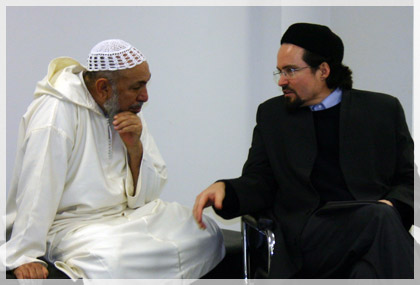
Saturday, December 24th, 2005 - Toronto, Canada
(Right to left) Student is reunited with teacher.

Saturday, December 24th, 2005 - Toronto, Canada
Reviving the Islamic Spirit Convention: Shaykh Abdallah bin Bayyah discusses "Muslims: Caught between ignorance and extremism."

Sunday, December 25th, 2005 - Toronto, Canada
Reviving the Islamic Spirit Convention: Evening session with Imam Zaid Shakir on "Reviving The Islamic Civilization Model."

Monday, December 26th, 2005 - Toronto, Canada
Reviving the Islamic Spirit Knowledge Retreat: Shaykh Hamza Yusuf translates for Shaykh Abdallah bin Bayyah.
Thursday, December 29, 2005
The Company One Keeps (Knowledge & Wisdom)
The Company One Keeps
Imam ‘Abdallah ibn ‘Alawi al-Haddad-may Allah bless his soul-mentioned in his kitab, al-Fusul al-’Ilmiyya wa’l-Usul al-Hikamiyya (Knowledge and Wisdom):
The company one keeps has major effects. It may lead either to benefit and improvement or to harm and corruption, depending on whether the company is that of pure and eminent people or people who are depraved and evil. This effect does not appear suddenly, but is a gradual process that unfolds with time. The Messenger of God, may blessings and peace be upon him, said, “A man will be with his companions.” And, “A man’s religion is that of his intimates, so let each of you consider who he becomes intimate with.” He also said:
A virtuous companion is like the merchant of musk. Either he will offer you some, you will buy it from him, or you will find him pleasant to smell. But an evil companion is like the bellows-blower, either he will scorch your clothes or you will receive a rotten smell from him.
If you wish to know whether those you mix and sit with increase or diminish your faith, religion, and actions, compare your state with regard to good character, praiseworthy intentions, resolution in performing acts of obedience, and goodness before and after their companionship. If you find that these acts have become stronger and more firmly established and that you have become more desirous of and interested in them, then know that this particular company is of benefit to your religion and your heart, and that if you continue with it you will gain even greater benefits and acquire many more good things, God willing. If, on the other hand, you find that your religion has grown weaker and shakier, know that this company is harmful, that its harm to your religion and your heart is evident, and that if you continue with it it will lead to even greater harm and evil, may God protect us! You should also compare the bad points you had before and after keeping that company. This is the way to evaluate one’s position vis-a-vis those with whom one mixes and takes for one’s companions. The decisive factor here is whether good or evil is more powerful and predominant. When goodness in that company is more powerful and predominant, then a wicked man who mixes with them may become attracted to goodness and its people; whereas when wickedness prevails and dominates, then it is to be feared that the good people who keep such company may become attracted to wickedness and its people.
These are subtle concepts known to people possessed of discernment and who have experience in such matters. [The Prophet] said, may blessings and peace be upon him, ” A good companion is better that solitude, and solitude is better than a wicked companion.” [The Prophet], may blessings and peace be upon him, was given a comprehensiveness of expression that no other man, whether of ancient or of recent times, was ever given.
Subscribe to:
Posts (Atom)